Pain in a social world
Social & Observational Pain
How do social experience and persistent pain shape one another?
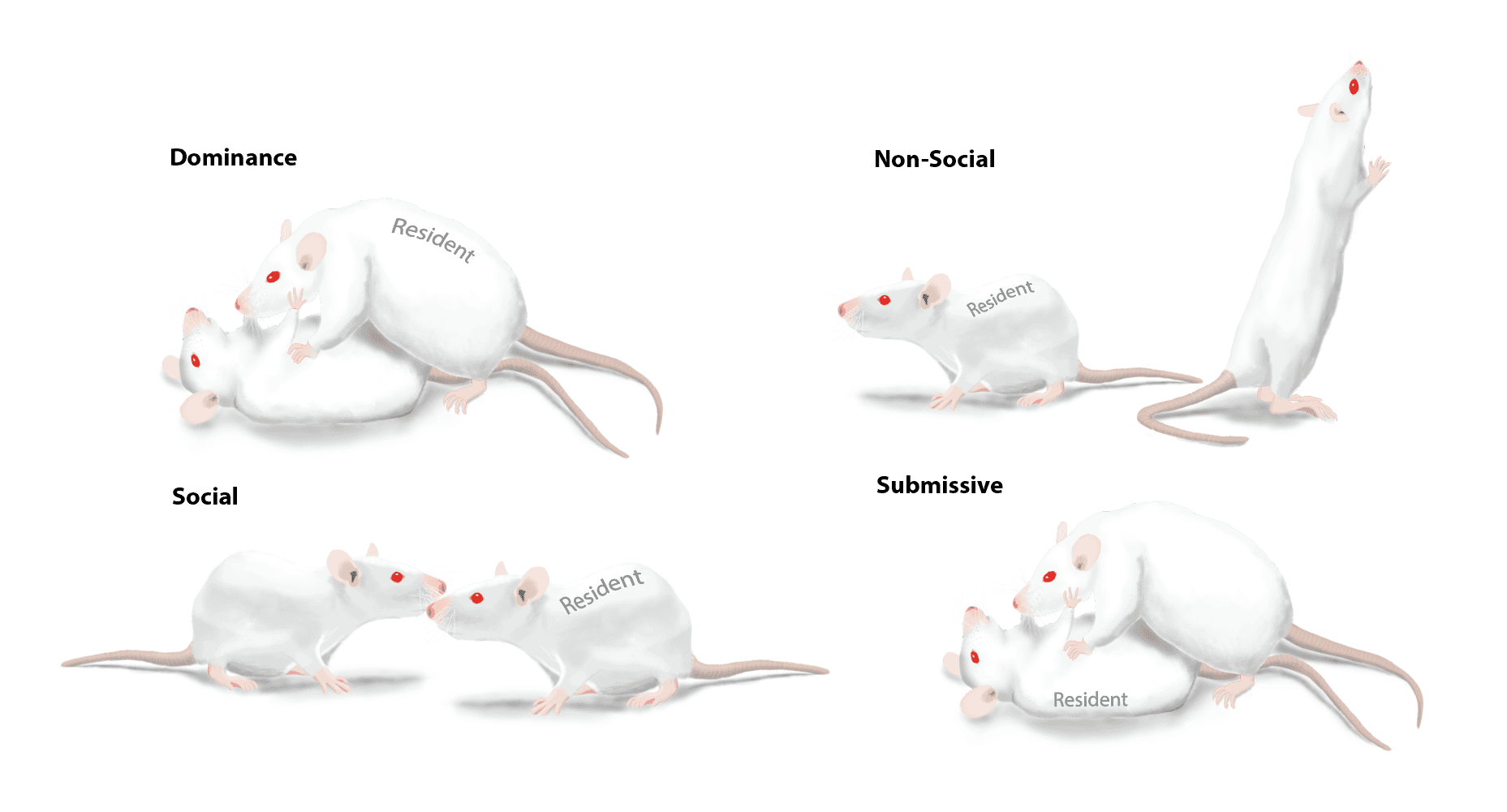
How I think about social and observational pain
Pain and social behaviour influence one another. Persistent pain can change how an individual engages with others, so I treat social behaviour as part of the pain phenotype rather than as background context.
The relationship also runs in the other direction. Observing or interacting with another individual in pain can alter the observer's own pain-related behaviour and neural activity, allowing socially derived information to be studied separately from the observer's injury state.
I therefore use social-interaction and observational paradigms as complementary ways to ask how pain is expressed, communicated and represented in the brain.
Current questions
Which social signals are sufficient to alter pain-related behaviour, and how can we separate the observer's response from the demonstrator's pain state? I am developing observational paradigms that allow these components to be measured more independently.
How does pain itself reshape social interaction over time, and what can richer measures of behaviour and communication reveal about that process? Computational behavioural analysis and ultrasonic vocalisations provide complementary ways to capture changes that conventional summary measures may miss.
What my studies have taught me
What I learned from this study
This study helped separate the effects of nerve injury from the effects of repeated social-interaction testing on stress-related brainstem systems. The absence of the predicted subgroup difference was informative because it shifted attention away from these catecholaminergic populations and toward other levels of the HPA-axis circuitry.
What I learned from this study
This study showed that persistent changes in social behaviour after nerve injury are accompanied by a distinct rebalancing of the HPA axis, even when basal corticosterone remains stable. It reinforced that social behaviour can identify meaningful pain-related subgroups with different underlying neuroendocrine adaptations.
Keay KA, Argueta MA, Zafir DN, Wyllie PM, Michael GJ, Boorman DC (2021).
Evidence that increased cholecystokinin in the periaqueductal gray facilitates changes in resident-intruder social interactions triggered by peripheral nerve injury
Journal of Neurochemistry 158(5):1151–1171 · 10.1111/jnc.15476.
What I learned from this study
This study linked persistent changes in social interaction after nerve injury to increased cholecystokinin signalling in the periaqueductal gray. Reproducing similar social disruption with local CCK administration provided evidence that the behavioural phenotype reflects a specific neurochemical adaptation rather than injury alone.