Expectation, learning and context
Placebo & Nocebo Across Species
How do expectation, learning and context change pain?
How I think about placebo and nocebo
My research has led me to think of placebo and nocebo effects as examples of the brain actively using prior experience and context to shape pain. Pain is not simply a readout of incoming sensory signals. What we have learned, what we expect, and the situation in which those signals occur can all change how strongly pain is experienced and expressed.
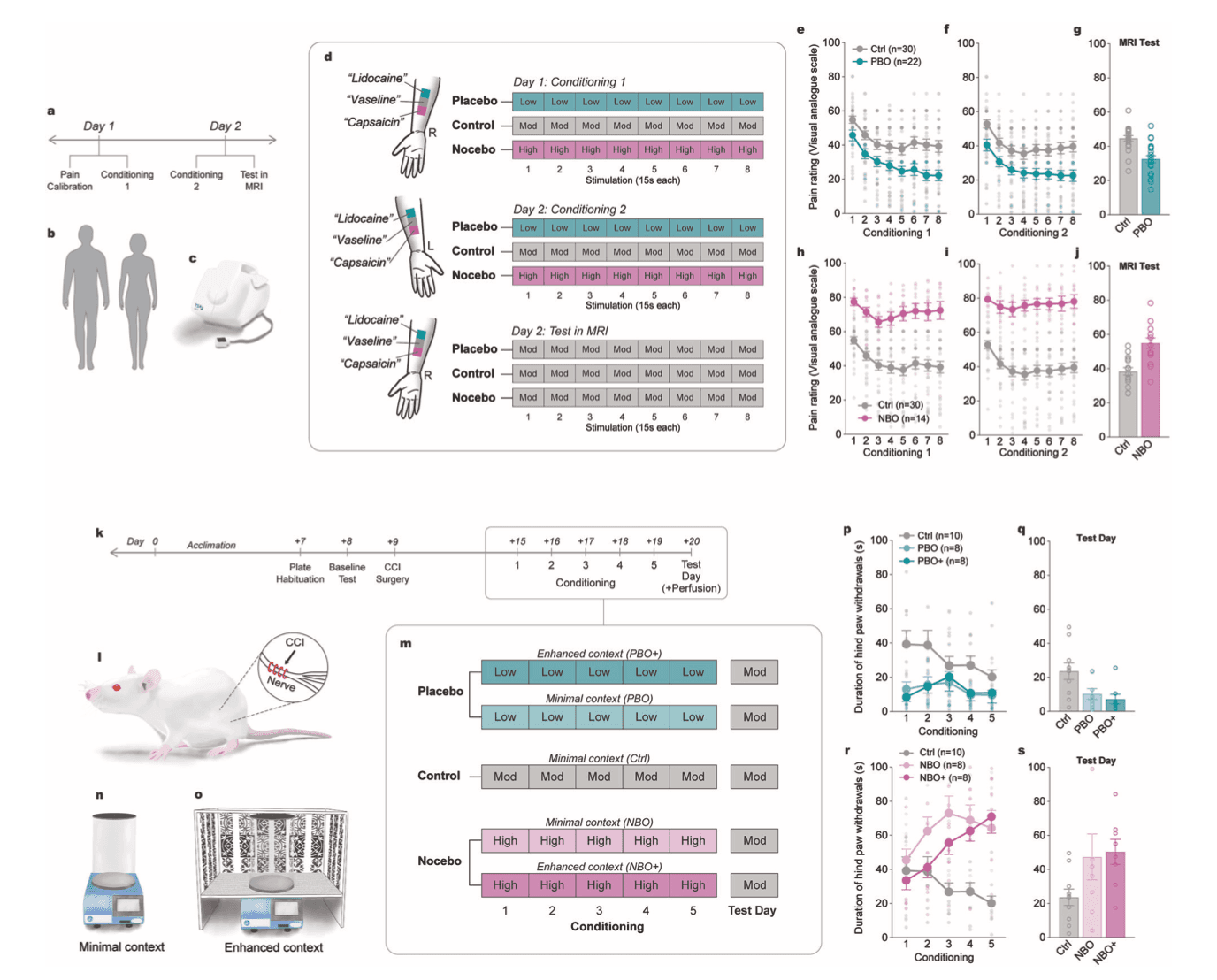
Placebo and nocebo effects provide a particularly useful way of studying this process because they allow us to experimentally manipulate those expectations and associations. In both humans and animals, cues that have previously predicted pain relief or worsening can later alter pain even when the underlying sensory stimulus is unchanged.
One thing that has become increasingly important to me is how variable these effects are. Some individuals show strong and persistent placebo or nocebo responses, while others show little or none. My work therefore increasingly asks not only how placebo and nocebo effects occur, but why they occur in some individuals and not others, which neural systems support them, and how much of this biology is shared across species.
Current questions
Why are placebo and nocebo effects strong and persistent in some individuals but weak or absent in others? I am interested in whether stable responder differences can be identified in brain-wide activity and then traced to specific circuits and neurochemical systems.
Which mechanisms of placebo and nocebo are genuinely conserved across species, and which are not? Closely aligned rodent and human experiments can help distinguish shared biology from species-specific implementations of pain modulation.
What my studies have taught me
What I learned from this study
This synthesis showed that placebo analgesia engages a focused part of the dorsolateral prefrontal cortex that overlaps substantially with areas involved in pain perception itself. It reinforced my view that placebo modulation is embedded within the wider cortical systems that evaluate and regulate pain.
What I learned from this study
Placebo responding is not simply an all-or-none characteristic of an individual. Repeated testing showed that these responses can vary over time, which made me increasingly interested in the stability of placebo responders and in understanding what distinguishes persistent responses from transient ones.
Poulson SJ, Skvortsova A, Zahra FT, Boorman DC, Karimi SA, Paz LV, Cui W, Mandatori A, Burek J, Siddiqi Z, Fazili M, Gami SR, Morgan OB, Di Maria M, Dinh A, Liang L, Contofalsky R, Mogil JS, Martin LJ (2026).
Cholecystokinin input from the anterior cingulate cortex to the lateral periaqueductal gray mediates nocebo pain behavior in mice
Nature Communications 17:6637 · 10.1038/s41467-026-73266-y.
What I learned from this study
This study moved the question from broad patterns of nocebo-related activity to a defined causal pathway. Finding that contextual and social cues converge on cholecystokinin signalling from the anterior cingulate cortex to the lateral periaqueductal gray showed how distinct experiences can recruit a shared pain-facilitating circuit.
What I learned from this study
Reviewing the neuropharmacology made clear that placebo analgesia in chronic pain cannot simply be inferred from acute-pain experiments. Chronic pain involves interacting neural, endocrine and immune adaptations, so its placebo mechanisms need to be tested directly in that biological context.
Boorman DC, Keay KA (2026).
Identifying the placebo and nocebo responders: two methods for eliciting placebo analgesia or nocebo hyperalgesia in rats with a neuropathic injury
In Translational Research Methods for Neuropathic Pain. Neuromethods, vol. 235, pp. 233–253. Springer · 10.1007/978-1-0716-5312-8_12. First published online September 2, 2026.
What I learned from this study
Bringing these two conditioning methods together made the identification of placebo and nocebo responders an explicit methodological problem. It clarified how experimental design can be used to study both the direction of learned pain modulation and the individuals in whom it is expressed.
Rehal SK, Boorman DC, Cho C, et al. (2026).
Whole-brain analyses identify anterior cingulate μ-opioid signaling as a critical mediator of placebo analgesia in neuropathic pain
Advanced Science — Under review.
What I learned from this study
This work connects whole-brain analyses with a more specific mechanistic test of anterior cingulate μ-opioid signalling. It reflects the progression I am most interested in: using distributed activity patterns to identify candidate systems and then testing their causal role in placebo analgesia.
What I learned from this study
Directly comparing placebo and nocebo-related brain activity across humans and rats reinforced for me that cross-species comparisons are possible, but that they are most useful when we resist expecting the two species to look identical. Some neural systems appear to be shared, while differences between species may themselves tell us something important about how these effects are generated.
Crawford LS, Wake A, Robertson RV, Peng A, Meylakh N, Boorman DC, Sattarov L, Ramachandran A, Macefield VG, Keay KA, Henderson LA (2025).
Conditioned Pain Modulation, Placebo and Offset Analgesia: Rates of Behavioural Expression of Inhibitory, Nonresponse and Facilitatory Pain Modulatory Effects
European Journal of Pain 29(7):e70088 · 10.1002/ejp.70088.
What I learned from this study
Comparing placebo analgesia with conditioned pain modulation and offset analgesia showed that similar proportions of people express inhibitory, nonresponse and facilitatory effects across these paradigms. It sharpened my interest in responder variation while also showing that similar behavioural outcomes can arise from partly distinct correlates and mechanisms.
What I learned from this study
This work showed me that learned contextual cues can bidirectionally alter pain behaviour even in the presence of persistent neuropathic pain. It strengthened my view of placebo and nocebo as learned pain-modulatory processes rather than phenomena that depend on verbal suggestion or uniquely human expectations.
What I learned from this study
This study showed that stronger pharmacological conditioning does not necessarily produce stronger conditioned analgesia. An escalating morphine regimen prevented the placebo response seen with a stable dose, emphasizing that the structure of prior treatment experience matters as much as its analgesic intensity.
What I learned from this study
This work established clear placebo-responder and nonresponder subgroups in rats with neuropathic pain, in proportions comparable to human studies. The lack of a responder-specific c-Fos signal in the classical rostral ventromedial medulla pathway redirected my attention toward broader networks and other candidate mechanisms.