Mechanisms and individual variation
Chronic Pain: Mechanisms & Individual Differences
How does nerve injury reshape neural, immune, endocrine and behavioural systems — and why do those changes differ between individuals?
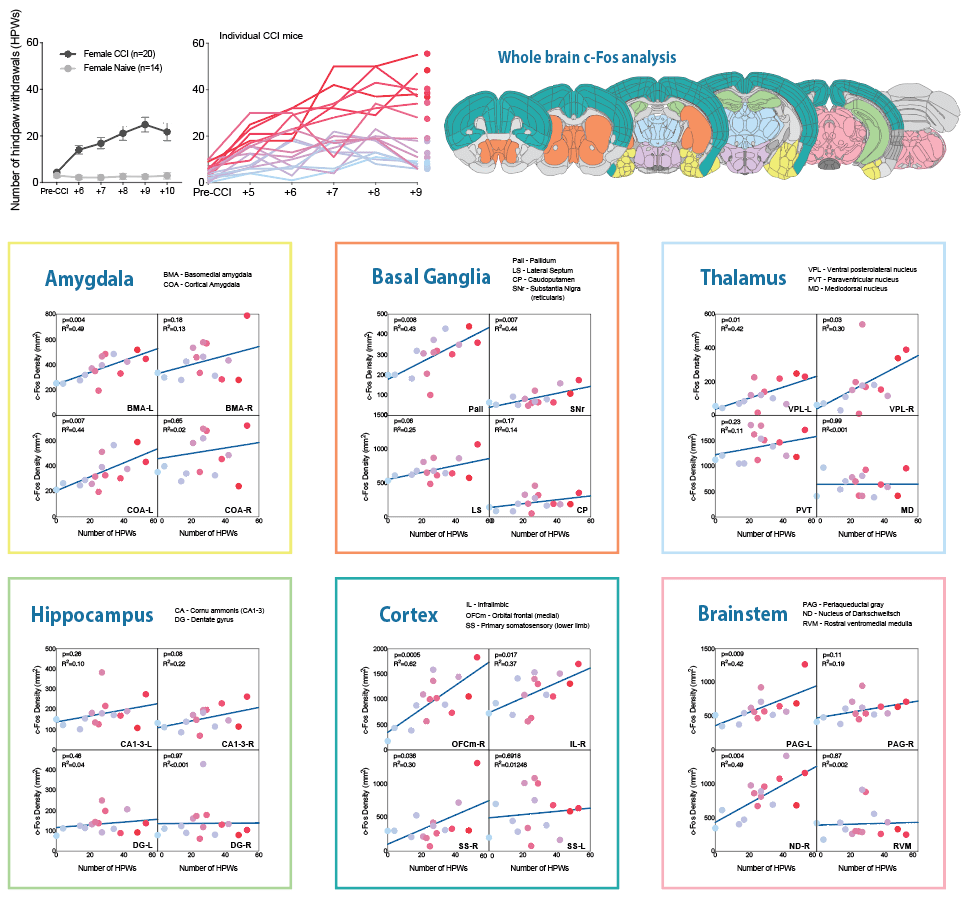
How I think about chronic pain and individual differences
Chronic pain is not a single biological state. The same injury can produce markedly different behavioural outcomes, and similar pain phenotypes can arise alongside different changes in neural, immune, endocrine and other biological systems.
My work aims to understand both the mechanisms that accompany persistent pain and the biological variation that helps explain why pain develops, persists or resolves differently between individuals.
I am particularly interested in linking behavioural trajectories with changes across multiple levels of biology, then using those patterns to identify more focused neural, cellular and molecular mechanisms.
Current questions
How do individual pain trajectories relate to brain-wide activity, and which biological differences help explain why those trajectories diverge? I am particularly interested in whether microglial and other immune changes, blood-based markers, and naturalistic behavioural phenotypes track susceptibility, persistence and recovery.
Can longitudinal measures of behaviour and neural activity reveal when and how those trajectories begin to separate? Combining approaches such as Keypoint-MoSeq and miniscope calcium imaging can help link evolving behavioural states to neural dynamics and guide more focused circuit- and cellular-level follow-up.
What my studies have taught me
What I learned from this study
Sex and genetic background shaped different aspects of the response to morphine, including locomotor behaviour and regional μ-opioid receptor expression. The findings reinforced that analgesic responsiveness is not one uniform trait and that biological variation needs to be modelled explicitly across behavioural and molecular outcomes.
What I learned from this study
Female and male rats with neuropathic pain differed in morphine sensitivity alongside distinct patterns of astrocyte density and morphology across pain- and opioid-responsive brainstem regions. This linked variation in analgesic response to neuroimmune biology and broadened the question of individual differences beyond neurons alone.
What I learned from this study
Nerve injury altered spinal NMDA-2D, CB1 and GFAP expression, but these molecular changes did not distinguish animals that developed persistent social-behaviour disruption from those that did not. This showed that a biological consequence of injury is not necessarily an explanation for individual pain-related disability, and that the relevant variation may lie elsewhere in the system.
What I learned from this study
Peripheral nerve injury attenuated the locus coeruleus response to an acute stressor, showing that injury reshapes neural responsiveness beyond the immediate nociceptive system. It connected persistent pain with altered stress and arousal biology and helped establish the broader systems-level questions that guide my current work.